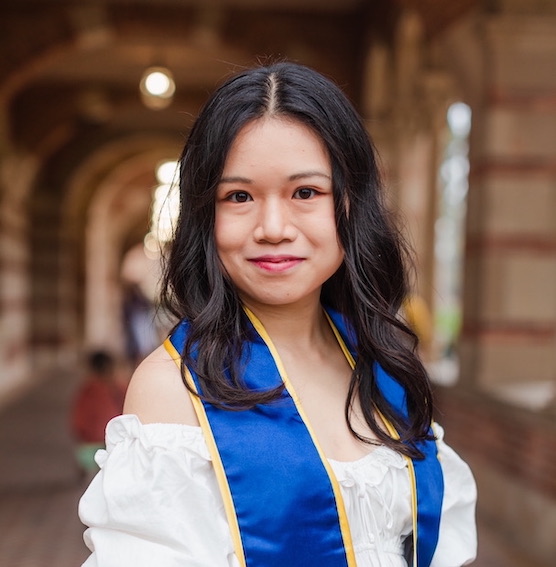
Hi! I’m Jingyou Rao, a Postdoctoral Researcher in the Coyote-Maestas Lab in the Department of Bioengineering and Therapeutic Sciences at UCSF.
I develop experimental and computational methods to map protein sequence–function relationships, combining deep mutational scanning (DMS), combinatorial mutagenesis, and statistical modeling. My research uses human olfactory receptors to study epistasis and functional diversification, and extends to membrane proteins such as CFTR to investigate genotype-dependent drug responses.
I build scalable cloning and screening strategies, including high-order combinatorial libraries, and integrate molecular biology, next-generation sequencing, and computational analysis to connect genetic variation with protein function and therapeutic response.
I received my PhD in Computer Science (Computational Biology) from UCLA in December 2025, advised by Harold Pimentel. My dissertation, Statistical and Computational Methods to Uncover the Genetic Architecture of Protein Function, focused on Bayesian methods for variant-effect estimation and uncertainty in DMS, residue-level summaries of functional variation, and relationships among molecular phenotypes. I also completed bachelor’s degrees in Computer Science and Computational and Systems Biology at UCLA in June 2021, graduating summa cum laude.
Recent News
- March 2026: Presented “Mapping the Protein Epistasis Landscape by Deep Mutational Scanning” at Probabilistic Modeling in Genomics in Berkeley.
- February 2026: Gave a flash talk on “Mapping the Protein Epistasis Landscape by Deep Mutational Scanning” at the Biophysics Society Annual Meetings in San Francisco.
- December 2025: Completed my PhD at UCLA and began as a Postdoctoral Researcher at UCSF, following my visiting scholarship in the Coyote-Maestas Lab (June 2024–December 2025).
Journal Publications
Accurate variant effect estimation in FACS-based deep mutational scanning data with Lilace. Jerome Freudenberg, Jingyou Rao, Matthew K. Howard, Christian Macdonald, Noah Greenwald, Willow Coyote-Maestas & Harold Pimentel. Genome Biology, 2026.
Rosace-AA: Enhancing Interpretation of Deep Mutational Scanning Data with Amino Acid Substitution and Position-Specific Insights. Jingyou Rao, Mingsen Wang, Matthew K. Howard, Christian Macdonald, James S. Fraser, Willow Coyote-Maestas & Harold Pimentel. Bioinformatics Advances, 2025.
dotears: Scalable, consistent DAG estimation using observational and interventional data. Albert Xue, Jingyou Rao, Sriram Sankararaman & Harold Pimentel. iScience, 2025.
Mapping kinase domain resistance mechanisms for the MET receptor tyrosine kinase via deep mutational scanning. Gabriella O. Estevam, Edmond M. Linossi, Jingyou Rao, Christian B. Macdonald, Ashraya Ravikumar, Karson M. Chrispens, John A. Capra, Willow Coyote-Maestas, Harold Pimentel, Eric A. Collisson, Natalia Jura & James S. Fraser. eLife, 2024.
Rosace: a robust deep mutational scanning analysis framework employing position and mean-variance shrinkage. Jingyou Rao, Ruiqi Xin, Christian Macdonald, Matthew K. Howard, Gabriella O. Estevam, Sook Wah Yee, Mingsen Wang, James S. Fraser, Willow Coyote-Maestas & Harold Pimentel. Genome Biology, 2024.
Preprints
- Cosmos: A Position-Resolution Causal Model for Direct and Indirect Effects in Protein Functions. Jingyou Rao, Mingsen Wang, Matthew K. Howard, Willow Coyote-Maestas & Harold Pimentel. bioRxiv, 2025.
Oral Presentations
- Mapping the Protein Epistasis Landscape by Deep Mutational Scanning. Biophysics Society Annual Meetings, San Francisco, CA (February 2026; flash talk).
- Statistical and Computational Tools to Decode Genetic Architecture of Protein Functions. Computational Genomics Research Institute, Los Angeles, CA (July 2025).
- Modeling Growth-based Deep Mutational Scanning Counts with Rosace. Atlas of Variant Effects, Variant Effect Seminar Series, virtual (August 2024). Recording.
- What is in a variant score? Mutational Scanning Symposium, Boston, MA (May 2024; workshop). Recording.
- Computational Approaches for Inferring Gene Regulation in in situ Perturbation Screens. CSHL Biological Data Science Conference, Long Island, NY (November 2022).
Poster Presentations
- Mapping the Protein Epistasis Landscape by Deep Mutational Scanning. Jingyou Rao, Matthew K. Howard, Claudia Llinas del Torrent, Ira Irkliyenko, Catherine H. Shin, Aashish Manglik & Willow Coyote-Maestas. Probabilistic Modeling in Genomics, Berkeley, CA (March 2026).
- Modeling Relationships in Multi-Phenotype DMS Using Graph Theory and Ensemble View. Jingyou Rao, Mingsen Wang, Matthew Howard, Ever O’Donnel, Willow Coyote-Maestas & Harold Pimentel. Mutational Scanning Symposium, Barcelona, Spain (May 2025).
- Decomposing the Position and Amino-Acid Substitution Effect in Deep Mutational Scanning. Jingyou Rao, Mingsen Wang, Chris Macdonald, Matthew Howard, James Fraser, Willow Coyote-Maestas & Harold Pimentel. Mutational Scanning Symposium, Boston, MA (May 2024).
- Quantifying Uncertainty in Estimation of Isoform Expression Heritability. Jingyou Rao, Nicholas Mancuso & Harold Pimentel. CSHL Genome Informatics, virtual (November 2021).
Community Service
Since December 2024, I have served on the Variant Effect Seminar Series Committee of the Atlas of Variant Effects Alliance, coordinating programming for more than 30 seminars and creating promotional content. I am also a member of its Data Coordination and Dissemination Workstream.
Mentoring
- Joanna Rhim, UCLA undergraduate in Computational and Systems Biology (2024–present), including the 2025 Bruins-In-Genomics Summer program: simulating double-mutant functional effects through epistatic interactions and hotspot enrichment via Tranception.
- Joanna Jiang, UCLA master’s student in Biostatistics (2024–2025): modeling protein position correlation in DMS using Gaussian processes. Now a Statistics PhD student at UC Davis.
- Ruiqi (Riley) Xin, UCLA undergraduate (2022–2024): software and website development for Rosace; co-author on Rao et al., Genome Biology (2024). Now a Bioinformatics PhD student at the University of Chicago.
- Jianping Ye, UCLA undergraduate (2021–2022): review of computational methods for pooled CRISPR screens. Now a Mathematics PhD student at the University of Maryland.
Teaching
Teaching Assistant, UCLA, Winter 2022: CSC121/C221 Probabilistic Models in Computational Genomics.
Software
I am the sole software developer of: